
Judging shop and product from photos and numbers alone
You cannot meet a Weidian seller or touch the goods, so every judgment comes from the listing: its photos, its option menu and its size table. Here is how to read those, and how a scout parcel turns a guess into a record.
Reading a shop through its other listings
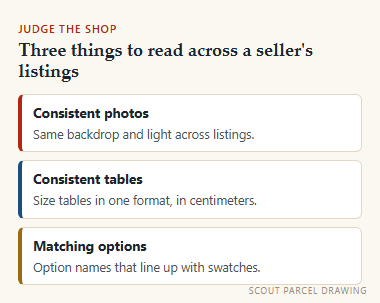
Start from the seller, not the single item. Open their other listings and look for consistency: photos taken in the same place and light, size tables written in the same format, option names that match their swatches. A seller who documents every listing the same way is usually organized in other ways too, and their sizing will carry over from one item to the next.
Depth matters for the scout method. A shop with several pieces you would buy is worth scouting, because one good result unlocks a whole follow-up order. A shop with one interesting item and nothing else gives your scout nowhere to go.
What careful listings have in common
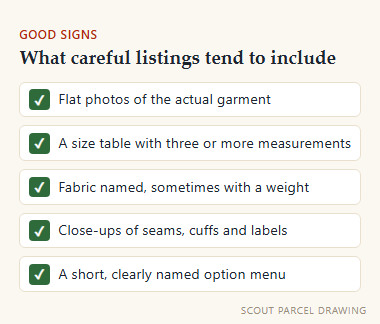
Good sellers tend to show the same things. There are photos of the actual garment laid flat, not only on a model. There is a size table with at least chest, length and sleeve, or waist, hip and inseam for pants. Fabric is named, sometimes with a weight in grams per square meter for tees and fleece. Close-ups show seams, cuffs and labels. Options are few and clearly named.
None of this guarantees a good item, but each one makes the warehouse photos easier to check against the listing, which is where most problems get caught. A listing that gives you numbers is a listing you can hold to account.
Signs that call for caution
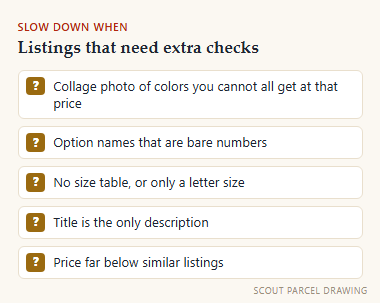
Be slower when the main photo is a collage of many colors that cannot all be bought at the card price, when option names are bare numbers that do not match the photo order, when there is no size table at all, or when the only description is the title. Be slower too when a price sits far below every similar listing in the aisle; it may be the cheapest option of a long menu, a deposit, or a different item.
Caution does not mean avoid. It means use the warehouse photos fully and ask for a measurement before accepting. These are also exactly the listings where a scout earns its cost, because the listing itself cannot answer your questions.
Three questions before an item joins the cart
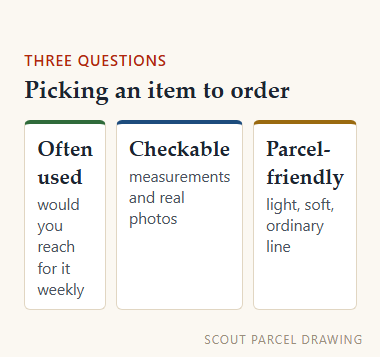
Deciding what to order is easier with three questions. Would you wear or use it often? Can you check it, meaning does the listing give measurements and real photos? And does it fit the parcel plan, meaning is it light, soft and allowed on ordinary lines? An item that passes all three is a good scout or a good follow-up. An item that fails the second is a gamble however much you like it.
Prefer items with fewer variables. A plain hoodie in one color has fewer ways to disappoint than a printed jacket with six options. The more variables an item has, the more it needs either excellent warehouse photos or a scout from the same seller first.
Where the real product gets chosen: the option menu
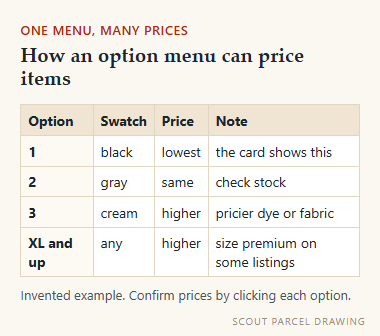
The option menu is where the real product is chosen. Each combination of color and size can carry its own price and stock, and the price on a catalog card is often the cheapest combination. Click through the options you want and watch the price; a larger size or a particular color can cost more.
Match options to swatches, not to photo order. If a menu lists "1, 2, 3", look at the small image attached to each and compare it with the gallery. When the swatch is unclear, put the exact option name and a plain description in your CNFans note, such as "option 2, the gray one", so the warehouse can confirm it in the photos.
Size letters mean little; the numbers mean everything
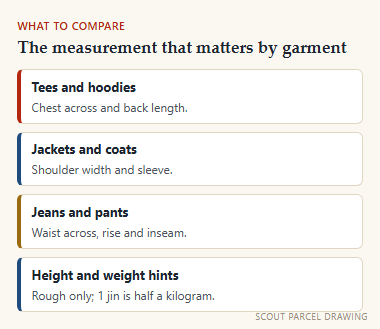
An L from one seller can be an M or an XL from another. Ignore the letter and compare the numbers in the size table with a garment you own and like, measured flat the same way. Note which measurement matters most for the item: chest and length for tees and hoodies, shoulder for jackets, waist and rise for pants.
Some tables also give a recommended height and weight range, sometimes in jin, a Chinese unit equal to half a kilogram. Treat those as rough hints only. Your own garment is the better ruler, and after a scout, the scout itself becomes your ruler for that seller.
The two-minute pass on any listing
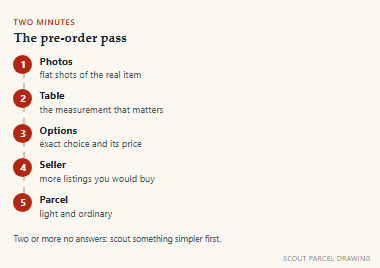
Before submitting anything, run the same short pass. Photos: are there flat shots of the real item? Table: does it have the measurement that matters for this garment? Options: do you know exactly which one you are buying and what it costs? Seller: are there other listings you would buy? Parcel: is it light and allowed on ordinary lines?
Five yes answers and the item is ready. Any no answer becomes a line in your CNFans note or a request for the warehouse, and two or more no answers suggest scouting this seller with something simpler first.
Keeping a seller file after the scout
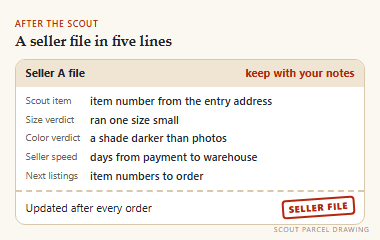
When the scout arrives, start a short file for that seller: the item number of the scout, the size you ordered, how it compared with the table, how the color compared with the photos, and the days the seller took to ship. Add the item numbers of listings you want next.
That file is the real product of a scout parcel. It turns the next order from a set of guesses into a set of adjustments, and it stays useful long after the hoodie has been worn in.