
Scout parcels: one CNFans item shipped ahead of the rest
Order the item you want most, ship it alone, and let its arrival answer the questions photos cannot. Here is the whole method, including what it costs and the cases where it is a waste of money.
Why one item goes first
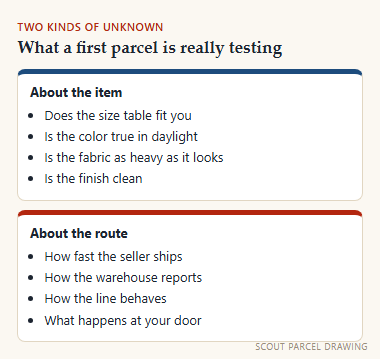
A first order through any agent has two kinds of unknowns. Some are about the item: does the size table match your body, is the color real, is the fabric as heavy as it looks. Others are about the route: how long the seller takes, how the warehouse reports, how the line behaves to your country, what happens at your door. A big first parcel tests all of them at once, on many items, and if three things disappoint you cannot tell which unknown failed.
One item isolates the answers. If the hoodie runs a size small, you know the seller's tables run small. If it took a long time, the dated log shows whether the seller, the warehouse or the line was slow. Your top find is the right item to send because you would buy it anyway, so the scout costs you only the extra shipping, not a purchase you did not want.
What a scout learns that warehouse photos cannot
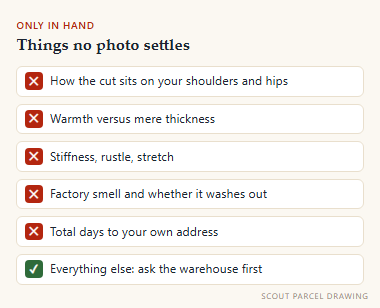
Warehouse photos answer a lot before shipping: the right option, the color against a white surface, a tape across the chest, visible flaws. Use them fully. But a photo cannot tell you how a cut sits on your shoulders, whether a fleece is warm or just thick, whether a jacket rustles, how stiff new denim feels, or whether a smell from the factory fades after a wash.
Nor can a photo show time. The total days from payment to doorstep, split into the seller's leg, the warehouse leg and the line, only exist once a parcel has made the journey. A scout gives you those numbers for your own address, which no forum post can.
Choosing the scout item
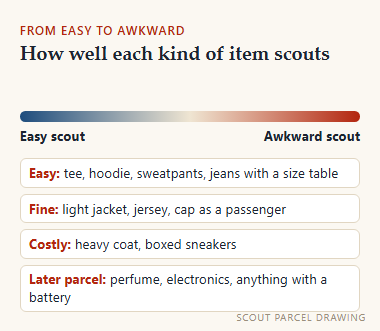
The scout should be the item you most want, but it also has to be a fair test. Prefer something with a size table, because sizing is the lesson that transfers most to later orders. Prefer something light and soft, because it ships cheaply and can go on almost any line. Avoid batteries, liquids, glass and anything boxed and heavy for the first parcel, since those can push you onto restricted lines and muddy what you learn about the ordinary route.
If your top find is a pair of boxed sneakers or a heavy coat, consider scouting the same seller with a lighter piece first, or accept that this scout will cost more and still teach you the most important thing: whether that seller is worth the haul.
Choosing which seller to scout
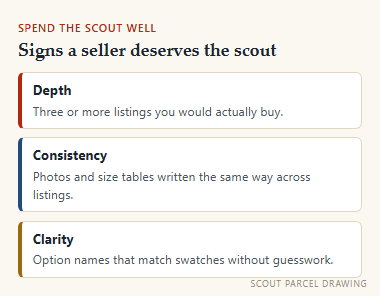
A scout judges a seller as much as an item, so spend it on the seller you would otherwise trust with a big order. That is usually a shop with several listings you want, consistent photos across those listings, and size tables written the same way each time. A scout from a seller you will never use again teaches you only the route.
Keep the seller's item numbers for the listings you want next. The catalog entry address ends in "w-" and the Weidian item number, which is the cleanest reference to give support or to find the listing again if a card disappears.
One passenger at most
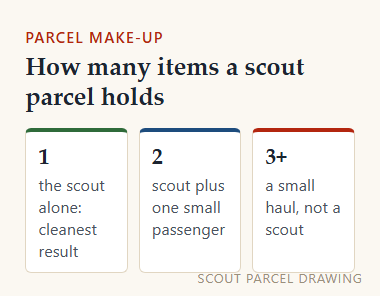
You can add one small item to a scout parcel without spoiling the test: a cap, a belt, a piece of jewelry, a pair of socks. It barely changes the weight band and lets you peek at a second seller. Two passengers is where the scout starts to become a small haul, and once three things arrive together it is harder to say which seller or which listing let you down.
If you add a passenger, pick it from a different seller than the scout. That way the parcel tests two sellers for nearly the price of one, and the main scout result stays clean.
The honest cost of shipping one item
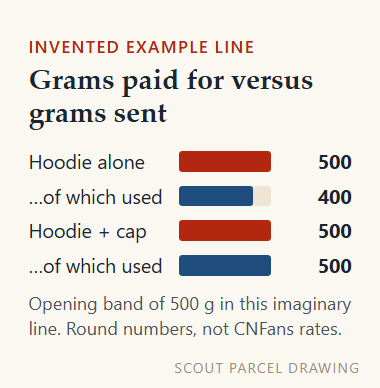
Most international lines charge by weight in bands, starting with an opening band you pay however little the parcel weighs. A single light item usually sits well inside that band, so its shipping cost per gram is the worst you will ever pay. Imagine a line whose opening band covers the first half kilo: a 400 g hoodie pays for the full 500 g, and adding a 100 g cap costs nothing extra. The same hoodie inside a three-kilo haul would carry only its own share.
So a scout always costs more shipping per item than a haul. Whether that premium is worth it depends on what the haul is worth and how much of it the scout can settle. If one scout stops you ordering four hoodies in the wrong size, it has paid for itself several times over. The illustration uses round, invented numbers; CNFans's real bands were not readable on 20 October 2026.
When to skip the scout entirely
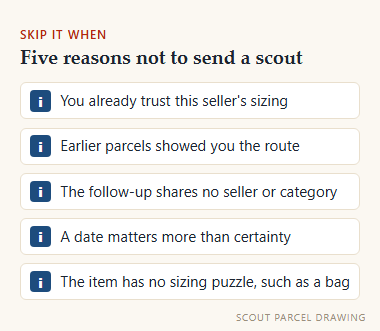
A scout is a tool, not a rule. Skip it when you have already received items from this seller in a size you trust, when earlier CNFans parcels to your address have shown you the route, or when the follow-up order shares nothing with the scout. The carry-over map shows that last case quickly: if the only lessons that carry over are the warehouse routine and the line, a scout mostly buys you a delivery-time estimate.
Skip it too when timing matters more than certainty, for example a gift with a date attached. A scout adds a full round trip before the main order even starts. And skip it for categories without sizing puzzles, such as a bag or sunglasses, where the warehouse photos and a tape across the base answer nearly everything.
Reading the result and placing the second order
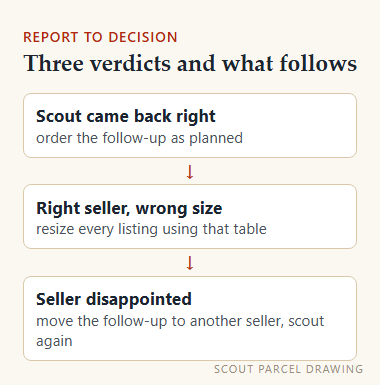
Write the report the day the parcel arrives, before the novelty wears off. Size: true to the table, small or large, and by how much compared with your own garment. Color: as photographed, darker or lighter. Fabric: heavier, as expected or thinner. Days: the seller's leg, the warehouse leg and the line. Then a verdict: buy more from this seller, buy more but change size, or move on.
Carry the verdict into the next order literally. If the scout ran small, size up on every listing from that seller that uses the same table. If the color came out darker, ask the warehouse for a daylight photo of the next item before accepting it. A scout report that does not change the second order was not worth writing.
Planning a scout while cnfans.com is paused
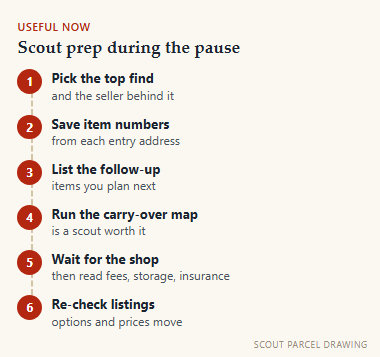
Ordering through CNFans is paused while its site shows the maintenance notice, but the slow part of a scout is the thinking, and that can happen now. Browse the aisles, pick the top find and the seller, save the Weidian item numbers for the follow-up listings, and run the follow-up through the carry-over map to see whether a scout is worth it at all.
When the shop returns, read its fee, storage and insurance articles first, then place the scout. Listings change over weeks, so re-open each saved listing before ordering and check that the option and price are still what you planned around.
When the sample fails: preserve the useful result
A scout that does not fit can still save a larger mistake. First separate a wrong item from an item that matches the listing but does not suit you. A size label matching the order does not settle the measurements, and matching measurements do not promise a comfortable fit.
For a hypothetical hoodie listed at 60 cm flat chest width, a clear 56 cm reading deserves a question about method and the seller’s stated tolerance. Do not infer a universal tolerance from this guide. Ask where the tape starts and ends, whether the fabric is stretched and which size was sent. Keep the reply next to the photo.
If a different tee from the same shop later says “L,” do not copy the hoodie’s letter size. Compare its own chart. If you are considering a return after international delivery, ask about the destination, postage, accepted condition and deadline before paying to send it back. A low item price can be outweighed by the return journey; the agent’s response and the seller’s terms decide the available options.