
What a CNFans Spreadsheet holds, and where its information stops
Aisles of product cards, each pointing to one listing on a Chinese marketplace that the CNFans agent can buy for you. Here is what the catalog holds, how an entry connects to a real listing, and where its information stops.
Catalog first, agent second
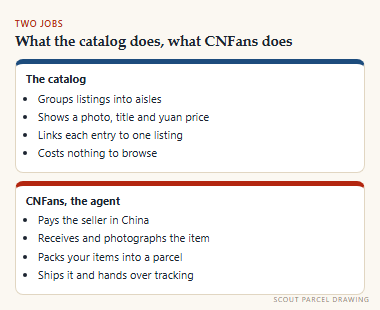
People use the word Spreadsheet for a browsable catalog of products from Chinese marketplaces, arranged in aisles by category so a shopper outside China can find things without reading Chinese store pages. The CNFans part names the shopping agent that does the buying. The catalog shows you what exists; CNFans is how you actually get it.
Keeping those two jobs apart helps. When something goes wrong with a card, such as a dead listing or a price that has moved, it is a catalog problem and costs you nothing. When something goes wrong after you submit an order, such as a wrong color bought or a parcel delayed, it is an agent problem and goes to CNFans support. A scout parcel tests the second kind of problem on one item before it can affect ten.
How one catalog entry connects to a real listing
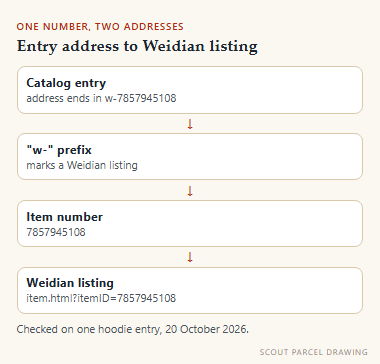
Every entry has an address ending in "w-" followed by a long number. We checked one on 20 October 2026: the entry for a hoodie ending in w-7857945108 linked out to weidian.com/item.html?itemID=7857945108, the same number. So the digits are the Weidian item number, and the "w-" says which marketplace the listing sits on. The entries we opened during this build all pointed to Weidian.
That number is useful. If a catalog card ever disappears, the item number still identifies the listing for CNFans support. And if you scout a seller and like the result, the item number of your scout is the cleanest way to say exactly which listing you mean when you write to anyone about it.
The limits of a thumbnail, a title and a price
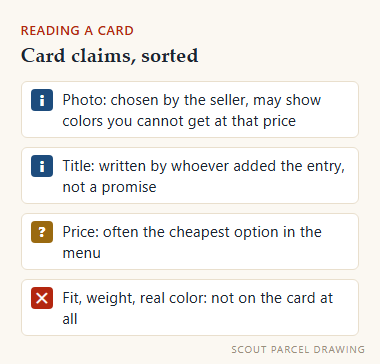
A card is a thumbnail, a title and a price. The thumbnail is chosen by the seller, often the most flattering of several photos, sometimes a collage of colors you cannot all buy at that price. The title was written by whoever added the entry and can name a style, a fabric or a label that the listing itself never promises. The price is usually the lowest option in the listing's menu.
What a card cannot tell you is how the item fits, how heavy it is, what the other options cost, or whether the color in the photo survives daylight. Those answers come, in order, from the entry page, the seller's listing, the warehouse photos and finally the item in your hands. This site is built around getting the last of those early, on one item.
Card price versus delivered total
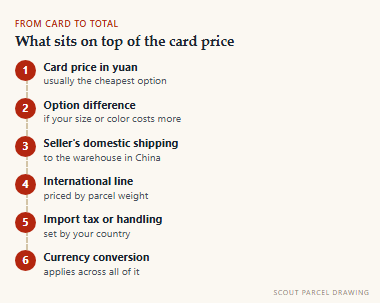
The yuan figure on a card is where the cost starts. On top of it come the seller's domestic shipping to the CNFans warehouse, any difference if you pick a pricier option, the international line charge once your parcel is weighed, and import tax if your country charges it. Currency conversion sits over all of it. A card that reads ¥190.00 is a starting line, not a total.
For a scout parcel the gap looks wider, because one light item still pays the opening weight band of a line. That is the honest cost of learning on one item. The costs page shows the pieces in the order they are charged.
Who maintains the catalog, and the gaps we leave on purpose
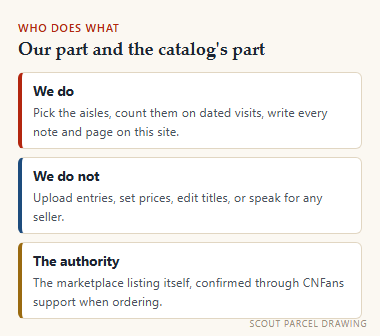
The catalog behind the aisle links is maintained separately from this guide. We choose which aisles to point to, count them on dated visits, write the notes under each card and keep the pages around them; we do not upload entries, set prices or edit listing titles. When an entry is wrong, the listing it points to is the authority, and CNFans support can confirm what the seller is actually offering.
This guide also leaves things out on purpose. It does not publish shop names or seller contact details, does not rank sellers with scores, and does not reproduce titles that lean on famous labels. It explains how to read what you see so the judgment stays yours.
Card titles that deserve a second look
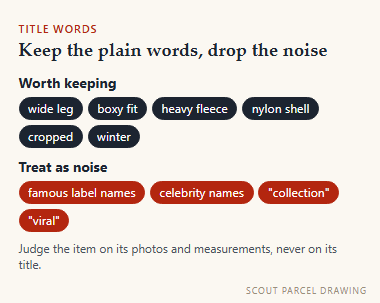
Many card titles mention a well-known label, a collection or a celebrity. Treat those words as noise. A title is not a certificate, the seller never wrote it on your behalf, and an item sold under someone else's trademark can be stopped at customs in many countries. This guide does not repeat such titles and does not help anyone shop for copies of trademarked goods.
Useful title words are the plain ones: a cut ("wide leg", "boxy"), a fabric ("fleece", "nylon"), a weight in grams, a season. When a title mixes those with a famous name, keep the plain words, look at the photos and the size table, and judge the item on what it is.