
After the warehouse: routes, bands and the border
Lines, weight bands, volume, combining items and the customs step, explained without invented rates. CNFans's own line list could not be read on 20 October 2026, so this page sticks to how agent shipping works and what to check yourself.
Lines: the routes an agent sells
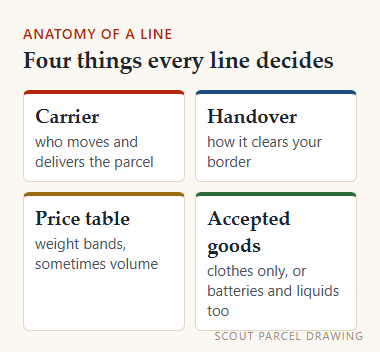
A shipping line is one of the named routes an agent sells between its warehouse and your country: a particular carrier or postal service, a particular way of handing the parcel over at the border, and a price table. Agents usually list several lines per country. They differ in speed, price per weight, how far tracking goes, and which goods they accept.
The archived CNFans home page described a shipping estimate page and "multiple international logistics providers" on one of its service cards. The estimate page itself was never archived, and on 20 October 2026 it returned the maintenance notice like every other address, so the lines for your country are something to read on CNFans directly once it is back.
Weight bands and the opening band
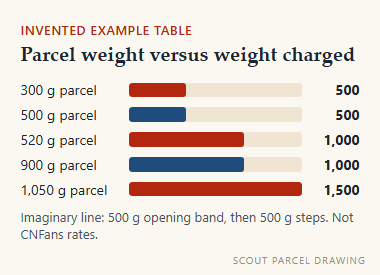
Most lines price by weight in steps. There is an opening band, often the first half kilo or the first kilo, that you pay in full even if the parcel weighs less. After that, each further step adds a set amount, and a parcel a few grams over a step boundary pays for the whole next step. Line tables are written in grams or kilos and in yuan or your currency.
Two habits follow. Weigh your plan against the bands: if a parcel sits just over a boundary, removing one light item may drop it a full step. And expect the opening band to make any single-item parcel look expensive per gram, which is the known price of a scout.
When a light, bulky parcel is billed by size
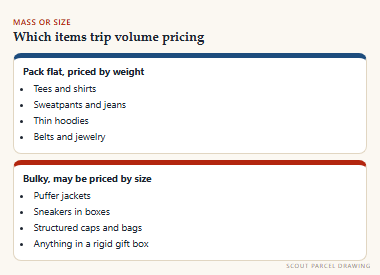
Some lines switch to a size-based charge when a parcel is big but light. The parcel's length, width and height are multiplied and divided by a number the line sets, and you pay for whichever is greater, the scale weight or that volume figure. Puffy jackets, boxed shoes and stiff caps are the usual victims.
Ask how CNFans packs bulky items when it is back, and whether shoe boxes can be removed. Line tables usually say whether volume pricing applies. For a scout, prefer an item that packs flat; a scout that gets charged by volume teaches you little about what a normal parcel costs.
Letting items gather before one parcel leaves
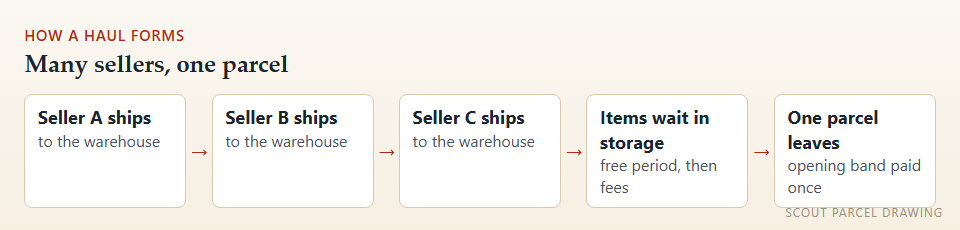
The archived CNFans service description said you could choose which stored items to combine and have them shipped home in one package. That is how every agent makes a haul affordable: items from many sellers wait at the warehouse, then travel together so the opening band is paid once.
Combining is why a scout is a deliberate exception. After the scout, the logic flips: let follow-up items gather at the warehouse until the parcel is worth the opening band, and remember that storage beyond the free period usually costs money. CNFans's storage terms were not in the archive, so read its Storage article before planning a long wait.
Batteries, liquids and other awkward goods
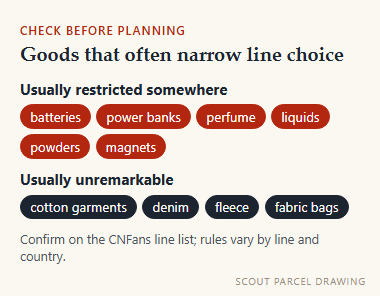
Across agents, goods with batteries, liquids, powders, magnets or sharp edges are often limited to particular lines, and some destinations do not accept them on certain lines at all. A single perfume or power bank can decide which line a whole parcel may use. The archived CNFans pages carried no list of refused items, so treat this as something to confirm, not assume.
Keep such items out of a scout parcel and out of your first haul if you can. Once you know how the ordinary route behaves, ship awkward goods separately on whatever line CNFans says accepts them.
Tracking and the days in transit
Once the parcel is on its way you receive a tracking code. The first updates usually come from the line's own system; later ones move to whichever company hands it over locally, sometimes with a fresh code. Several silent days running are ordinary, typically while the parcel sits at an airport or clears the border.
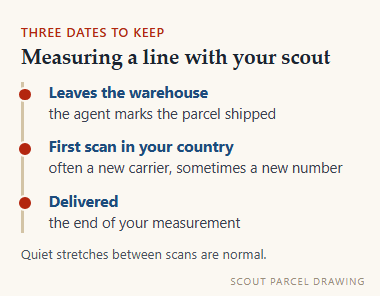
For a scout, note three dates: when it left the warehouse, when it first scanned in your country, and when it was delivered. Those three dates are your own measurement of the line, worth more than any average quoted elsewhere because they describe your address and your season.
The customs step belongs to your country
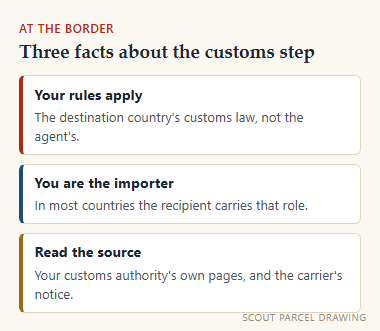
When a parcel enters your country, your country's customs rules apply, and in most places the person receiving the parcel is treated as the importer. Whether tax or a handling fee is due depends on local rules about value, type of goods and how the parcel arrives. Carriers usually contact you if something is owed.
This site does not interpret customs law for any country and does not advise on how to fill in any customs form. Read your own customs authority's pages on buying goods from abroad, and ask the carrier if a notice arrives. Items sold under someone else's trademark can be stopped at the border in many countries, which is one more reason to judge items on what they are, not on their titles.
The right line for a scout
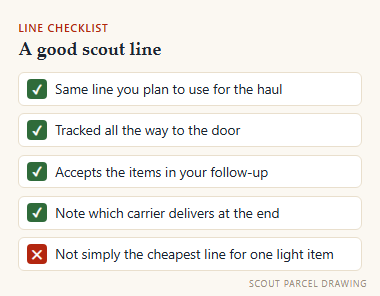
Pick the line you expect to use for the follow-up order, not the cheapest line for one light item. A scout's job is to measure the route you will rely on, and a budget line that only suits single small parcels measures nothing useful. Make sure the line is tracked to the door and accepts the kind of items the follow-up will hold.
If CNFans offers a line that changes carrier at your border, note who delivered the scout. That last-mile carrier is the one whose doorstep habits, notices and pick-up points you will meet again with the bigger parcel.